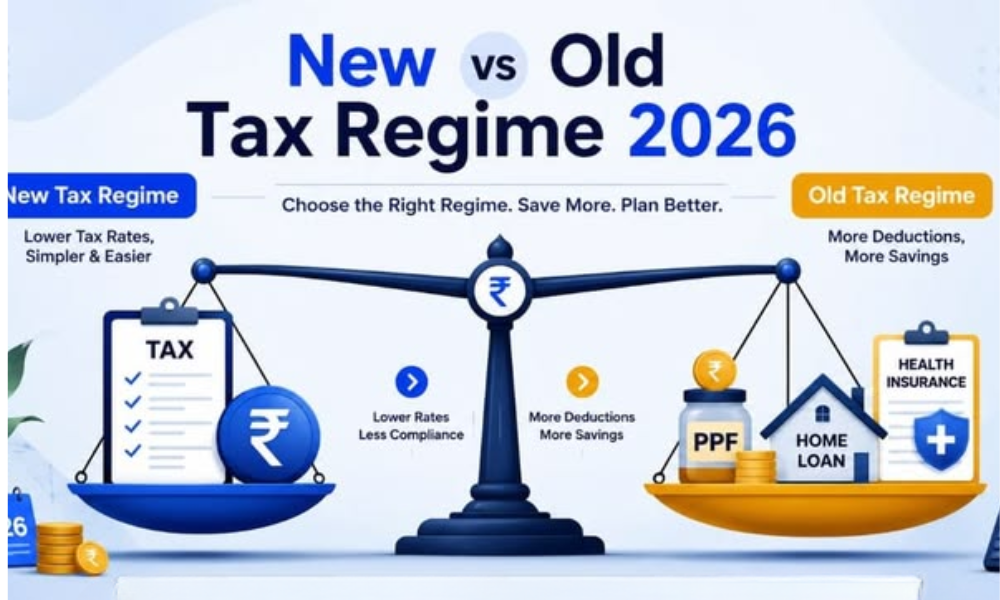
New Tax Regime vs Old Tax Regime: Which is Better for Salaried Employees in 2026?
Every
year, when the financial year draws to a close and salary slips pile up on
desks across India, millions of salaried employees face the same deeply
uncomfortable question: which tax regime should I choose? It sounds like a
simple administrative decision tick a box, submit a form but it is anything but
simple. The choice between the New Tax Regime and the Old Tax Regime can
silently cost you tens of thousands of rupees if you get it wrong, and save you
just as much if you get it right.
The
confusion is understandable. The government introduced the New Tax Regime in
Budget 2020 with the promise of lower slab rates and reduced paperwork. Then in
FY 2023-24, it flipped the script by making the New Regime the default option
meaning unless you actively declare otherwise, you are automatically placed
under the new structure. For many employees, this change happened silently,
without them even realising which regime their employer was deducting taxes
under.
But
the lower headline rates of the New Regime do not automatically translate into
lower taxes for everyone. The Old Regime, with its rich network of deductions
and exemptions, still offers a legitimate path to paying significantly less tax
provided you have the right financial habits, the right investments, and the
right understanding of what you are entitled to claim. For someone who has
maximised their Section 80C, pays premiums on a health
insurance plan and a term
insurance policy, lives in a rented house, and services a home loan,
the Old Regime can reduce their taxable income by ₹5–6 lakh before the
government even begins calculating what they owe.
This
guide is written for salaried employees who want to move past the confusion and
understand with real numbers, real scenarios, and real financial context which
tax regime actually puts more money in their pocket in FY 2026-27.
Why This Choice
Exists and Why It Matters More Than Ever
To
understand the debate, it helps to understand what each regime was designed to
do. The Old Tax Regime has been the foundation of India's income tax system for
decades. It was built around the philosophy of incentivising savings and
investment rewarding people who bought life insurance, contributed to provident
funds, paid home loan instalments, and invested in pension schemes. In return,
the government allowed those expenses to reduce the amount of income on which
tax was calculated. The system worked, but it also created enormous complexity.
Employees had to track dozens of exemptions, collect proof documents, submit
declarations to their employers, and still potentially face notices from the
Income Tax Department.
The
New Tax Regime was meant to solve that complexity. The idea was
straightforward: give people lower slab rates in exchange for removing the web
of deductions. Pay less without the paperwork. For younger earners, new employees,
or those without significant financial commitments, this was genuinely
attractive. For someone in their mid-career with a home loan, a family to
insure, and investments already running across PPF, ELSS, and NPS the New
Regime was a trap that looked like a gift.
The
government has been nudging people toward the New Regime. The standard
deduction under the New Regime was raised from ₹50,000 to ₹75,000 in Budget
2024. The rebate under Section 87A was extended to cover incomes up to ₹7 lakh
under the New Regime, which effectively makes tax zero for anyone earning up to
that threshold without needing any additional deductions. These are meaningful
improvements, and they have made the New Regime genuinely competitive for
lower-income employees. But they have not eliminated the advantage the Old
Regime holds for employees with higher incomes and well-structured financial
portfolios.
Understanding the Tax
Slabs: What the Numbers Actually Say
The
New Tax Regime for FY 2026-27 operates on six income slabs. Income up to ₹3
lakh is fully exempt. Between ₹3 lakh and ₹7 lakh, tax is charged at 5%. From
₹7 lakh to ₹10 lakh, the rate steps up to 10%. Between ₹10 lakh and ₹12 lakh,
it is 15%. From ₹12 lakh to ₹15 lakh, the rate is 20%. And anything above ₹15
lakh is taxed at 30%. On top of all this, a standard deduction of ₹75,000 is
available without any documentation. If your total income after this deduction
stays at or below ₹7 lakh, the Section 87A rebate eliminates your tax liability
entirely.
The
Old Tax Regime uses a simpler three-slab structure but with different
thresholds and a lower standard deduction of ₹50,000. Income up to ₹2.5 lakh is
exempt. Between ₹2.5 lakh and ₹5 lakh, the rate is 5%, and a rebate under
Section 87A ensures zero tax up to ₹5 lakh of income. From ₹5 lakh to ₹10 lakh,
the rate jumps to 20% significantly higher than the New Regime's 10% for the
same band. Above ₹10 lakh, the Old Regime charges 30%, same as the New Regime
at its peak.
On
pure rate comparison, the New Regime looks convincingly better especially in
the ₹7 lakh to ₹15 lakh band where the differences are most pronounced. A
person earning ₹10 lakh faces a 20% rate on income between ₹5–10 lakh under the
Old Regime, compared to just 10% on the ₹7–10 lakh band under the New Regime.
That is a meaningful difference. But here is where most people stop reading,
and where they make their most expensive mistake: they compare rates
without comparing taxable income. The Old Regime, through its deductions,
allows you to shrink the income on which those rates are applied. And that is
what changes the entire calculation.
The Deductions You
Surrender When You Choose the New Tax Regime
When
you opt into the New Tax Regime, you are not simply choosing lower rates. You
are making an explicit decision to forgo every major deduction and exemption
that India's tax law has built over the last several decades. Understanding the
full weight of what you are giving up is critical before making this choice.
Section
80C is perhaps the most significant sacrifice. Under the Old Regime, you can
reduce your taxable income by up to ₹1.5 lakh annually by channelling money
into investments like the Public Provident Fund, Equity Linked Savings Schemes,
fixed deposits with a 5-year lock-in, the principal component of your home
loan, or by paying premiums on a life
insurance policy. For the many salaried employees whose employer
deducts Employee Provident Fund contributions, a significant part of this ₹1.5
lakh limit may already be used automatically. Under the New Regime, none of
this counts the EPF contributions still happen, but they offer no tax relief.
Section
80D is another major loss. The premiums you pay on health
insurance for yourself and your family can be deducted up to ₹25,000
per year. If your parents are senior citizens (above 60 years), the additional
premium you pay for their coverage can bring a separate deduction of up to
₹50,000. Together, that is ₹75,000 in deductions from health insurance alone deductions
that vanish the moment you step into the New Regime. If you are buying a family
health plan or a senior citizen health insurance policy, the Old
Regime is the only way these premiums reward you at tax time.
HRA,
or House Rent Allowance, is the most powerful deduction for salaried employees
living in rented accommodation. The exemption is calculated based on a formula
involving actual HRA received, actual rent paid, and the city of residence with
metro cities getting more generous treatment. A professional in Mumbai or Pune
paying ₹20,000 per month in rent can claim an HRA exemption of ₹1.2–₹2 lakh per
year depending on their salary structure. This deduction disappears completely
in the New Regime.
Section
24(b) allows a deduction of up to ₹2 lakh per year on the interest paid on a
home loan for a self-occupied property. For anyone who has taken a loan of ₹40
lakh or more at current interest rates, the annual interest outgo in the early
years of the loan easily exceeds ₹2 lakh. This is real money being spent, and
the Old Regime recognises it. The New Regime does not.
Beyond
these, the New Regime also eliminates Section 80CCD(1B), which allows an
additional ₹50,000 deduction for contributions to the National Pension System
Tier-1 account over and above the 80C limit. It removes LTA exemptions for
travel expenses, Section 80E for education loan interest, professional tax
deductions, and savings account interest deductions under 80TTA. In totality,
an employee who has built their financial life around these deductions can lose
anywhere between ₹3.5 lakh and ₹6 lakh in deductible income — an amount that,
when taxed at 20–30%, represents a real cash outflow of ₹70,000 to ₹1.8 lakh
per year.
Real Salary Scenarios:
Seeing the Numbers Play Out
Abstract
comparisons only go so far. The real clarity comes from walking through actual
numbers with realistic profiles. Three salaried employees at different life
stages, earning different incomes, with different financial structures illustrate
how the choice plays out in practice.
The
First Profile: Rohan, Age 28, Annual CTC ₹8 Lakh
Rohan
is three years into his career. He lives with his parents in Pune, so there is
no rent and no HRA claim. His EPF contribution is about ₹72,000 per year, and
beyond that, he has not yet built a systematic investment portfolio. He does
not have a home loan. Under the Old Regime, his gross income of ₹8 lakh is
reduced by the ₹50,000 standard deduction and ₹72,000 in EPF contributions under
80C, bringing taxable income to roughly ₹6.78 lakh. His tax works out to
approximately ₹47,000 plus health and education cess.
Under
the New Regime, his ₹8 lakh income is reduced only by the ₹75,000 standard
deduction, making taxable income ₹7.25 lakh. Because this exceeds the ₹7 lakh
rebate threshold by ₹25,000, he does owe some tax but the lower slab rates mean
his liability comes to approximately ₹32,500 plus cess. The New Regime saves
Rohan roughly ₹15,000 without him having to do anything differently. For
someone at this stage of life and career, the New Regime is a clear and easy
winner.
The
Second Profile: Priya, Age 35, Annual CTC ₹15 Lakh
Priya
is a senior software professional working in Bengaluru. She rents a 2BHK
apartment for ₹18,000 per month, which gives her an HRA exemption of
approximately ₹1.2 lakh annually based on her salary structure. She has
maximised her Section 80C through a combination of LIC premiums, PPF
contributions, and ELSS investments totalling ₹1.5 lakh. She pays premiums on a
family
health insurance plan covering herself, her husband, and two
children, which gives her a Section 80D deduction of ₹25,000. She also
contributes ₹50,000 to NPS under Section 80CCD(1B), and she services a home
loan (property in her hometown, rented out) with annual interest of ₹2 lakh
claimed under Section 24(b).
When
all deductions are added ₹50,000 standard deduction, ₹1.5 lakh under 80C, ₹1.2
lakh HRA, ₹2 lakh home loan interest, ₹25,000 health insurance, and ₹50,000 NPS
her total deductions reach ₹5.95 lakh. This brings her taxable income under the
Old Regime to just ₹9.05 lakh. At Old Regime slab rates, her tax liability
comes to approximately ₹1.06 lakh including cess.
Under
the New Regime, she gets only the ₹75,000 standard deduction. Her taxable
income is ₹14.25 lakh. Applying the New Regime slab rates, her tax comes to
approximately ₹1.79 lakh including cess. The Old Regime saves Priya nearly
₹73,000 per year. Over a decade of her career, that is over ₹7 lakh in savings a
significant amount that can fund a child's education or build a retirement
corpus. For Priya, there is simply no contest.
The
Third Profile: Amit, Age 42, Annual CTC ₹25 Lakh
Amit
is a senior manager at a manufacturing firm in Nashik. He owns his home (no
rent, no HRA), and his home loan is partially paid down, with annual interest
now at ₹1.5 lakh. He has maxed out Section 80C and pays premiums on a senior citizen health insurance plan for his
parents, giving him a ₹50,000 deduction under 80D. He does not contribute to
NPS.
His
total deductions under the Old Regime ₹50,000 standard deduction, ₹1.5 lakh
under 80C, ₹1.5 lakh home loan interest, and ₹50,000 parents' health insurance add
up to ₹3.5 lakh. Taxable income becomes ₹21.5 lakh, with a tax liability of approximately
₹4.87 lakh including cess.
Under
the New Regime with only the ₹75,000 standard deduction, his taxable income
rises to ₹24.25 lakh, with tax at approximately ₹5.02 lakh. The Old Regime
still saves him about ₹15,000, but the gap is narrower. If his home loan were
fully repaid, the New Regime would likely overtake the Old Regime for him. This
shows exactly how the break-even point shifts depending on the combination of
deductions available to a given individual.
The Insurance
Dimension: What Most Tax Articles Get Wrong
There
is a dangerous narrative that surfaces every year around tax-filing season, and
it goes something like this: "Since the New Regime doesn't allow
deductions, there's no point buying insurance for tax benefits." This
thinking conflates two fundamentally different questions what saves you money
at tax time, and what protects your family's financial future and conflating
them can have devastating consequences.
The
purpose of a term insurance policy is not to save ₹2,000 in
taxes on your premium. Its purpose is to ensure that if you are no longer
around, your family does not have to sell their home, pull children out of
school, or struggle to maintain the life you built together. A ₹1 crore term
cover for a 30-year-old typically costs between ₹8,000 and ₹12,000 annually a
sum that should be non-negotiable regardless of which tax regime you have
chosen. The 80C deduction it offers in the Old Regime is a welcome side
benefit. It is not the reason to buy it, and it should never be the reason to
skip it.
The
same logic applies to health insurance. A single hospitalisation in an Indian
city today whether for surgery, an accident, or a cardiac event can cost
between ₹3 lakh and ₹8 lakh. The group health cover your employer provides is
often inadequate in terms of sum insured, and it disappears the moment you
leave the organisation. A comprehensive health
insurance plan for your family, or a dedicated family
health plan with adequate coverage, is a financial necessity. The
Section 80D deduction it yields under the Old Regime up to ₹25,000 for self and
family, and another ₹50,000 for senior citizen parents is a genuine and
meaningful tax benefit. But its absence in the New Regime should motivate you
to choose your tax regime wisely, not to reduce your coverage.
For
those with parents in their 60s or 70s, the senior citizen health insurance dimension
deserves particular attention. The 80D deduction for senior citizen parents is
₹50,000 among the most generous individual deductions available under the Old
Regime. If you are already paying significant premiums to ensure your parents
have quality hospitalisation coverage, the Old Regime rewards you substantially
for doing the right thing.
It
is also worth considering critical illness insurance, which provides a
lump-sum payout upon diagnosis of specified conditions like cancer, kidney
failure, stroke, or heart attack. Unlike health insurance that reimburses
treatment costs, critical illness cover replaces lost income during the
recovery period often six months to two years when these conditions are
involved. Whether or not this premium generates a tax deduction, the financial
logic of holding this cover is sound for any earning member of a household.
The Key Deductions
That Power the Old Regime
For
employees wondering whether the Old Regime is worth the complexity, the answer
largely depends on whether they can accumulate enough deductions to
meaningfully reduce their taxable income. There are five pillars that typically
make the Old Regime win.
The
first is HRA. For salaried employees living in rented accommodation,
particularly in Tier-1 and Tier-2 cities, the House Rent Allowance exemption is
the single most powerful weapon in the Old Regime arsenal. Someone paying
₹20,000 per month in rent in a metro city can exempt between ₹1.2 lakh and ₹2.4
lakh from taxation depending on their salary components. No other single
deduction comes close to HRA in terms of its impact for urban employees.
The
second pillar is Section 80C. The ₹1.5 lakh ceiling here can be filled through
a combination of mandatory EPF contributions, voluntary PPF investments, ULIP plans,
endowment
plans, ELSS mutual funds, or five-year tax-saving fixed deposits.
The beauty of 80C is that many of these investments PPF, EPF, ELSS also build
long-term wealth, making it possible to save on taxes while simultaneously
growing a corpus. Explore investment plans that combine both objectives
effectively.
The
third pillar is home loan interest under Section 24(b). For employees in the
first decade of a home loan when interest forms the bulk of their EMI the ₹2
lakh annual deduction on self-occupied property interest is highly significant.
On a ₹50 lakh loan at 8.5%, annual interest in year one is approximately ₹4.2
lakh, of which ₹2 lakh is deductible. That ₹2 lakh deduction saves ₹60,000 in
taxes for someone in the 30% bracket.
The
fourth pillar is the NPS contribution under Section 80CCD(1B). This ₹50,000
deduction is available over and above the ₹1.5 lakh ceiling of Section 80C,
making it genuinely additive. NPS also serves as an excellent pension
plan vehicle, accumulating a retirement corpus in a structured,
government-backed account that matures when you need it most.
The
fifth pillar is health insurance premiums under Section 80D. As discussed, the
combined deduction for self, family, and senior citizen parents can reach
₹75,000 equivalent to half of 80C's ceiling. For families with ageing parents,
this deduction alone can tip the balance between the two regimes.
The Break-Even Point:
A Framework for Your Decision
Rather
than debating in the abstract, there is a practical framework you can apply to
your own situation. The question to ask is not "which regime has lower
rates?" but rather "what is my total deductible amount, and how much
does it reduce my tax liability compared to the New Regime's lower rates?"
The
approximate break-even point works like this: if your combined deductions including
the standard deduction differential between the two regimes exceed ₹3.75 lakh
for incomes in the ₹10–15 lakh range, the Old Regime is likely better. For
incomes above ₹15 lakh, the threshold rises to approximately ₹4.5 lakh in total
deductions before the Old Regime clearly wins, because the New Regime offers
lower rates on more income bands.
Practically
speaking, if you are paying HRA and have a fully utilised 80C, you have already
crossed ₹3 lakh in deductions. Adding health insurance premiums, an NPS
contribution, and home loan interest makes the Old Regime almost certainly
superior. If you have none of these if you own your home outright, have no
dependents to insure, and have no systematic investments the New Regime's
simplicity and lower rates are a genuine advantage.
The
most important habit to develop is running this calculation every year, because
life changes. A new home loan, a newborn child requiring a child
insurance plan, parents requiring medical coverage, or the start of
NPS contributions can all shift the break-even point meaningfully from one year
to the next.
The Long-Term
Financial View: Tax Regime as One Piece of a Larger Picture
There
is a broader truth that gets lost in the annual tax regime debate: the choice
between Old and New Regime is one decision within a larger financial planning
framework, and it should not be made in isolation.
Employees
who choose the New Regime for its simplicity and then stop buying insurance,
stop investing in PPF, or reduce their NPS contributions because "there's
no tax benefit anyway" are making a category error. They are treating tax
deductions as the reason to make good financial decisions, rather than
understanding that good financial decisions adequate life cover, health
insurance, retirement savings, emergency funds are valuable regardless of the
tax treatment they receive.
The
correct sequence is to first establish what your financial life requires: how
much life
insurance does your family need, what level of health coverage is
adequate, how much should go into a pension
plan for retirement, do you need a money-back
plan for a medium-term goal like your child's education or a home
purchase? Once you have answered those questions honestly, you will naturally
find yourself with a portfolio of financial products. Then, and only then, does
it make sense to calculate which tax regime rewards that portfolio more
generously.
If
the answer is the Old Regime, you have the added benefit of tax efficiency
built on top of sound financial planning. If the answer is the New Regime, you
keep your investments and insurance intact for all the right reasons, and you
accept the tax regime that works with your current deduction profile. Either
way, the financial foundation comes first.
Making the Final
Call: A Summary for Salaried Employees
The
New Tax Regime is the right choice for you if your taxable income falls at or
below ₹7 lakh, since the rebate under Section 87A eliminates your tax liability
entirely making the regime unambiguously superior. It also makes sense if you
are in the early years of your career without HRA claims, home loans, or
maximised investments, because the lower slab rates genuinely reduce your
burden without requiring you to change your financial behaviour.
The
Old Tax Regime remains the right choice if you are a mid-to-senior career
employee with a combination of HRA, Section 80C investments, health insurance
premiums for your family and parents, home loan interest, and NPS
contributions. If your aggregate deductions including the standard deduction exceed
₹3.75 lakh, the Old Regime will almost certainly produce a lower final tax
liability despite its higher headline rates.
The
most important thing to avoid is making this decision based on what your
colleague did, what your HR told you by default, or what seemed simpler at the
beginning of the year. Run the actual numbers with your actual income and
actual deductions. Revisit the calculation every year as your income and
financial commitments evolve. And ensure that the insurance coverage and
investments you hold are built on financial logic first, with tax efficiency as
a welcome outcome not the other way around.
Conclusion:
For
personalised guidance on structuring your financial portfolio across life
insurance, health plans, investment
options, and retirement planning in a way that works with your
chosen tax regime, speak with a Policywise advisor today.


Comments (0)